Frequently Asked Questions
Nuclear fusion is a process in which light atomic nuclei combine, releasing a large amount of energy (this is also what happens in the Sun). It is important because it offers a clean, safe, and virtually inexhaustible energy source that could replace environmentally polluting fossil fuels.
Fusion technologies can be divided into two main categories:
- Magnetic Confinement Fusion (MCF), which uses strong magnetic fields to confine plasma (e.g., tokamak, stellarator)
- Inertial Confinement Fusion (ICF), which uses lasers or particle beams to compress fuel to extreme densities and temperatures for a very short time
In addition, there are alternative approaches (e.g., magnetized target fusion - MTF, z-pinch), which are still in the experimental stage.
WGM-MIF-CPA is a hybrid fusion concept that combines the principles of Inertial Confinement Fusion (ICF) with Magneto-Inertial Fusion (MIF) and Cavity Pressure Acceleration (CPA) mechanisms, complemented by Whispering Gallery Mode (WGM) laser-plasma coupling.
- The CPA mechanism converts laser energy into a high-density, high-velocity plasma flow using plasma pressure generated in a closed cavity, significantly improving energy transfer efficiency.
- WGM-based energy coupling enables localized energy deposition on the surface of microcavity structures.
- The MIF component enhances plasma confinement and reduces thermal losses using a dynamic magnetic field.
- The MIF approach enables spin-polarized fusion, as the application of a strong magnetic field aligns the spins of plasma particles in a preferred direction before fusion interactions occur. The goal is to increase the reaction cross-section and anisotropy, while the system dynamically competes with depolarization processes (collisions, turbulence, spin relaxation), which tend to rapidly destroy polarization. The key to effectiveness is maintaining spin ordering over the ~10 ns timescale of the fusion process.
The key architectural concept is distributed ignition: instead of a single hotspot (as in classical ICF), a chain reaction of many micro-hotspots (“avalanche ignition”) is created, which - together with converging shock waves and magnetic compression - results in extremely high densities.
Implication: This approach may enable ignition with lower (kJ-level) laser energy and points toward compact, modular (~10-100 MWe) fusion systems, in contrast to traditional large-scale ICF facilities.
The system utilizes the energy of a single laser across many small regions, where fusion is initiated at multiple points and then propagates in an avalanche-like manner.
- Laser energy distribution and coupling (WGM)
- A kilojoule-class laser is divided into multiple beams
- The beams circulate along the walls of microcavities, transferring energy as they propagate
- Plasma is generated on the cavity walls
- Plasma formation and magnetic field generation (MIF)
- A pre-magnetizing field is created by plasma currents and return currents, while secondary magnetic fields are generated by charged particles exploding toward the center, and magnetic flux is frozen in during plasma compression. These effects reinforce each other, resulting in an extremely high-intensity, dynamically evolving, nearly spherically symmetric magnetic field
- This field:
- aligns the spins of plasma particles in a preferred direction
- compresses the plasma
- confines the particles
- Micro-explosions and shock waves (CPA)
- Small “explosions” occur within the microcavities
- These generate shock waves that propagate toward each other
- The waves converge and add up → resulting in extreme compression
- Hotspots and ignition (fast ignition)
- Many small hotspots are formed
- · Fusion is initiated at these hotspots
- Avalanche fusion (chain reaction)
- The generated particles and shock waves trigger additional reactions
- Fusion propagates through the material as a chain reaction
Energy is utilized not at a single point, but across many locations.
The plasma becomes denser and hotter (meeting fusion conditions).
The system further enhances fusion conditions.
Ignition does not occur at a single point, but simultaneously at many locations.
The process becomes self-amplifying.
Summary of the operating principle:
distributed ignition + magnetic compression + shock waves + avalanche effect
The technology initiates many small, mutually reinforcing fusion processes simultaneously, which rapidly amplify and produce large amounts of energy—much more efficiently than a single large implosion.
In the Infroton WGM-MIF-CPA avalanche fusion concept, efficiency does not come from extremely high laser energy, but from efficient laser energy utilization, spin polarization, and self-amplifying processes.
- Efficient energy coupling (CPA + WGM)
- Distributed ignition instead of a single hotspot
- Avalanche (self-amplifying) fusion
- Magnetic and structural amplification (MIF + microcavities)
Polarized laser energy is concentrated within microcavities, where it builds up pressure in a confined space and couples efficiently to the plasma via WGM modes → more usable energy is delivered with lower input power.
Classical ICF focuses energy into a single point, whereas here many micro-hotspots form simultaneously → there is no need to concentrate extreme energy into one location.
Initial reactions trigger further reactions → the system becomes partially self-sustaining, so less external energy is required.
The magnetic field confines and compresses the plasma, while microcavities and shock waves further increase pressure → the injected energy is effectively “amplified.”
Summary: The system relies on efficient coupling + distributed ignition + self-amplification + magnetic compression, rather than brute-force energy input—eliminating the need for extremely large laser facilities.
The Infroton capsule is a microscale (Ø ≈ 1.8-2.5 mm), multi-shell, kilojoule-class fusion target driven by a whispering gallery mode (WGM) p-polarized laser, based on a combination of magneto-inertial fusion (MIF) and cavity pressure acceleration (CPA).
Structural design
The capsule consists of concentric and functional elements:
- Outer shell (CD₂ polymer + Cu coating)
- Provides mechanical stability and partial radiation reflection
- Forms the microcavity structure
- Laser entrance window + cavity (≈ 0.2-1 mm)
- Allows injection of a single kJ-class laser
- Enables energy accumulation within the cavity (CPA mechanism)
- Copper beam splitter (WGM structure)
- Splits a single laser beam into ~8 circulating (whispering gallery mode) beams
- Ensures quasi-symmetric heating
- Copper circuit / return current (magnetic field generator)
- Laser-induced currents generate a self-induced magnetic field
- Provides partial magnetic confinement of the plasma (MIF)
- Fuel pellet
- Porous cryogenic deuterium or room-temperature LiD fuel
- Contains an internal spherical cavity connected to the laser input window
Operating mechanism
The capsule operates through three coupled processes:
- WGM laser distribution
- A single laser is divided into multiple circulating beams
- Energy is deposited along the cavity walls
- CPA (cavity pressure acceleration)
- Plasma fills the cavity
- A high-pressure, inward-directed shock wave is formed
- MIF (magnetic confinement)
- A self-induced magnetic field is generated
- Reduces thermal conduction and increases confinement time
Fusion dynamics
- Initial stage: plasma formation and spin polarization
- Multiple hotspots are formed
- Primary fusion: D-D reactions (trigger)
- Production of tritium and helium
- Dominant secondary fusion: D-T and D-³He reactions
- → avalanche-like burn propagation
Result
- ~30% burn fraction
- ~60-80 keV temperature range
- ≈ 60-120 MJ fusion energy (at ~1 mg deuterium scale)
- Burn products: deuterium (~0.3 mg), helium-3 (~0.15 mg), tritium (~0.1 mg)
Overall effect: Multiple hotspots collectively initiate a chain-reaction-like fusion process, resulting in rapid amplification and high energy output.
Deuterium-based fusion offers the best physical-engineering compromise in terms of availability, ignition conditions, and system integration.
Availability
- Deuterium is abundant in seawater, making it practically inexhaustible and inexpensive
- Tritium is rare, expensive, and radioactive
- Helium-3 is extremely scarce and therefore costly
- Proton-boron-11 (p-B¹¹) fuel is available, but requires temperatures of several billion °C, which are not achievable with current technology; furthermore, alpha ash cooling effects make it uncertain whether Q > 1 can be exceeded
Physical conditions
- D-D fusion requires higher temperatures than D-T, but significantly lower than D-³He or p-B¹¹ reactions
- This makes it a realistically achievable plasma state
- Especially for Infroton WGM-MIF-CPA technology, which has already validated the Lawson fusion criteria required for D-D fusion
Engineering feasibility
- Deuterium does not require radioactive fuel handling or complex breeding cycles
- It integrates well with localized ignition and magnetized systems
System-level advantage
- D-D reactions produce tritium and helium-3
- This enables self-sustaining secondary reactions (D-T and D-³He)
- No need for tritium breeding or helium-3 mining (e.g., from the Moon)
Summary: Deuterium is the only fuel that is simultaneously globally available, physically achievable, and engineering-scalable, while also being a low-cost energy source—making it essential for long-term fusion energy production.
Note: As other companies have not yet achieved the conditions required for D-D fusion (unlike Infroton), this highlights the uniqueness of the approach.
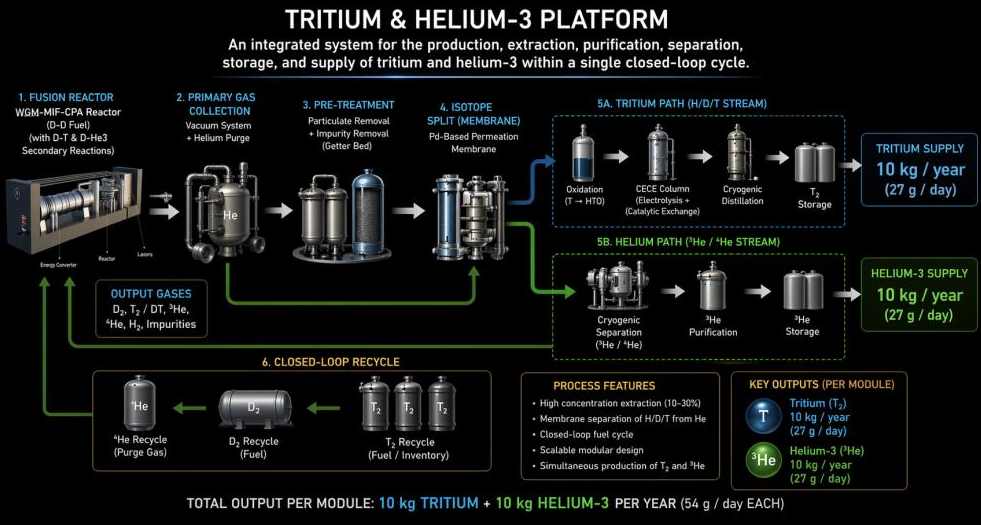
Infroton's D-D-based system not only produces energy, but also directly generates isotopes that are currently among the most critical and scarce resources in the fusion industry.
Natural byproducts of the D-D reaction
Deuterium-deuterium fusion proceeds through two main channels:
- D + D → T + p
- D + D → ³He + n
This means that tritium (T) and helium-3 (³He) are produced directly in the primary reaction. However, not all of the generated T and ³He proceed to secondary reactions (D-T, D-³He) → a significant fraction remains and can be extracted.
Key advantage of the Infroton approach
These isotopes:
- are present not at ppm levels, but at relatively high (even percentage-level) concentrations
- are therefore much easier and more efficient to extract compared to conventional lithium-blanket systems
Market value (order of magnitude)
- Tritium: ~30,000 - 100,000 USD per gram
- Helium-3: ~100,000 - 1,000,000 USD per gram (depending on application)
Implication: The byproducts of D-D fusion can represent hundreds of millions of USD in value, in addition to the energy produced—making the system not only an energy source, but also a strategic isotope production platform.
- Creation of the fusion reaction
- Heat energy extraction
- Electricity generation
Magneto-inertial fusion (MIF) with cavity pressure acceleration (CPA), using kJ-class WGM lasers. Deuterium (D) or LiD capsules are heated with ≈500 J-1 kJ laser energy, generating high-temperature plasma.
The energy produced by fusion appears as heat, which is removed by a helium coolant flowing through a ceramic pebble-bed reactor.
The heat is converted into electricity using a Brayton turbine or TPV (thermophotovoltaic) cells (~45% efficiency), with a single module producing ~35 MWe of power
- Generation and control
- Moderation and absorption
- Built-in safety
- Civil infrastructure: invisible protection
Neutrons are produced during deuterium fusion and can be partially directed (anisotropic emission).
A multi-layer pebble bed (graphite, SiC, B₄C) with boron coating slows down and absorbs neutrons, converting their energy into heat.
There is no chain reaction → the process is initiated only by the laser. In case of failure, it stops immediately, making the system inherently and passively safe.
Shielding and cooling are integrated into infrastructure, for example by installing the system beneath an artificial lake.
Low production cost: 6.5 USD/MWh.
Fusion reactions do not produce greenhouse gases, and unlike nuclear fission, they do not generate long-lived radioactive waste.
Our power plants are cheaper than solar power plants and require significantly less space.
Infroton strategy and future
- Fuel and self-sufficiency
- Deuterium: inexpensive and abundant (seawater)
- The system also produces tritium and helium-3 → enabling fuel self-sufficiency
- Industrial scalability
- Containerized ~35 MWe modules → rapid deployment and parallel scaling
- Standardized capsules and reactors → gigafactory-level mass production
- Competitiveness
- Low LCOE (~23.95 USD/MWh)
- Clean and safe technology → potential industrial standard for global energy supply